 Proudly Made in India


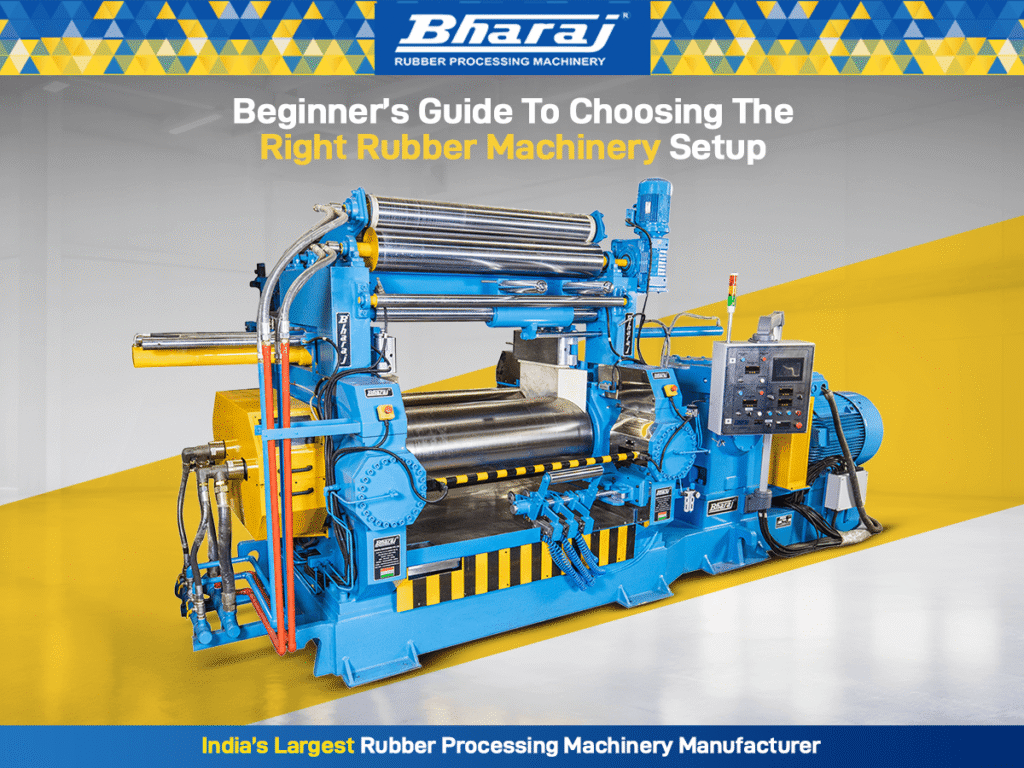
Beginner’s Guide To Choosing The Right Rubber Machinery Setup
The establishment of a rubber production line may seem to be a difficult task due to various production processes, different types of rubber products, and changing technology, deciding for what rubber machinery to purchase is very important for the quality of products produced, as well as the long-term operation costs (having an impact on all four of these criteria).
For first-time manufacturers of rubber, it will be essential for the manufacturer to thoroughly understand the entire manufacturing process, including the preparation of raw materials through to the shaping of the final product. Properly designing the machinery layout for production will improve overall efficiency and provide uniformly high-quality rubber compounds, as well as an uninterrupted flow of production.
This resource contains helpful information about the primary factors that should be considered in selecting the most appropriate equipment for constructing a reliable rubber production line.
How To Understand The Rubber Manufacturing Process
To properly invest in any rubber machinery, first, you should learn about the major steps involved in the manufacturing of rubber. In general, the rubber production line has the following steps:
- Receiving and weighing raw materials
- Mixing and compounding
- Milling and forming the sheets
- Processing and forming
- Moulding and curing
- Finishing and inspecting
Each step requires specific rubber processing machineries to accomplish one thing – maintaining batch consistency and minimising the amount of time that the material is being handled within the system.
Outlining an overall process flow will allow for the selection of machinery that is appropriate for the production capacity, type of product produced, and available plant space.
Establishing Your Product Specifications
Once you know which type of rubber product you are going to make, you can then determine what type of equipment configuration is needed based on the needs of that product. Some examples of the types of rubber products include automotive parts, seals, shoes, electrical cables, and rubber parts for industrial uses. Based on the end product, there are different ways to produce rubber products and also different curing methods.
For instance:
- Compression Moulding is best used for simple rubber parts.
- Transfer Moulding will be used for rubber parts that have inserts or will be bonded to metal components during cure.
- Injection Moulding is used when making large quantities of accurately produced rubber parts.
The selection of rubber moulding machinery is based on several factors, including cycle time, complexity of the product, and tolerances needed on all dimensions of the product.
Choosing The Most Appropriate Mixing Equipment
Mixing is the most important part of processing rubber. The dispersed distribution of fillers and/or oils together with additives must be consistent in order for the mechanical and physical properties of the final rubber product to be uniform.
Beginners should choose mixing equipment based on:
- Batch size
- Type of rubber compound
- Production volume
- Energy efficiency
Today’s rubber manufacturing machinery provides better control of temperature, rotor speeds, and discharge devices, which will assist in creating very uniform compounds with very little wasted materials.
Efficiently mixed compounds create fewer downstream defects and greater efficiencies during moulding.
Significance Of Performing And Milling Process
Following the mixing procedure, it is common to run the compound through a mill in order to create sheets or strips. This operation provides proper homogenization and makes it ready for the next step of forming.
The selection of milling equipment must consider:
- Roll diameter and roll speed
- Cooling efficiency of the cooling system
- Safety characteristics
Rubber processing machineries provide an essential function by controlling the gauge thickness of the finished product and preparing the compound for forming. Performing will allow better material flow into the moulding process and will reduce cycle time.
Choosing an Appropriate Moulding Technology
Rubber is shaped by moulding into the final product. Selecting the right rubber moulding machinery is vital to ensuring that your rubber products will be dimensionally accurate, have an acceptable surface finish, and will cure consistently.
The following are key factors to consider when choosing a rubber moulding process:
- Clamping force requirements
- Heating system efficiency
- Automation level
- Mould size compatibility
Beginners often do not understand the importance of even temperature control and uniform pressure distribution in the final product. Advanced rubber moulding machinery allows for improved quality through uniformly cured parts and reduced rejection rates.
Examining Current And Future Production Capabilities And Growth Rates
A frequent error in the beginning stages of any industry is miscalculating your production capacity. Selecting machines based on today’s needs often leads to failure as new business develops. The selection of rubber processing machinery should include consideration of future growth opportunities, in addition to current levels of need.
A rubber processing machine that can be scaled will allow:
- Increase in production volume using the same equipment with minimal retooling costs
- Addition of automation at a later date
- Inclusion of more than one press during initial installation
Planning to use scalable machinery will have a significant impact on how often equipment will need to be replaced, which contributes to your business’s long-term viability.
Automation And Process Control
Automation plays an ever-more critical role in rubber manufacturing. Automation systems using PLC control, temperature monitoring, and automated material handling have improved repeatability and reduced human error.
Today’s modern rubber processing machines with automation capabilities allow for:
- Recipe-Based Batch Control
- Real-Time Monitoring of Production Parameters
- Data Logging for Quality Assurance and Tracking
This allows even the beginner operator to produce consistent output despite limited experience.
Operating Costs And Energy Efficiency
Energy used in the rubber processing sector can be a key area of operational costs for companies processing rubber. Choosing energy-efficient machinery can help reduce electricity costs and result in overall improved profitability.
Select equipment for rubber processing based on the following:
- Optimized motor power;
- Efficient heating systems; and
- Reduced idle electricity consumption.
Reducing energy use can help reduce operational expenses, and it also provides the benefits of assisting companies in becoming environmentally responsible manufacturers.
Space Planning And Plant Layout
Correctly designing your facility will provide a more efficient flow of materials and require less time to handle materials. Before finalizing your equipment, the new user needs to consider the following items:
- Available space on the floor for the equipment
- Movement of materials between processes
- Safety clearance for the machines surrounding the machines
- Utilities connecting to the equipment, such as electrical power, cooling water, and compressed air
By creating a compact and efficiently designed layout, the new user will be able to increase production and reduce operator fatigue.
Testing Equipment And Quality Control
Testing equipment is as important as the machines used to produce the product. Hardness Tester, Tensile Testing Machine, and Rheometer will help track the performance characteristics of the material being fabricated from the compounded product.
These Rubber Processing Supporting Machinery are essential in creating product consistency and satisfying customer specifications; however, they are often an afterthought.
Working With Reliable Equipment Suppliers
Choosing the right equipment supplier is just as important as choosing the actual machines. As a new rubber moulding manufacturer, getting support from your supplier is crucial because of the level of expertise you’ll need to get started.
An experienced supplier will assist with:
- Planning your processes
- Selecting your machinery for the purpose you’re going to use it for
- Training your employees to operate your machinery
- Providing maintenance and support for your equipment
Working with a good supplier will help eliminate delays in setting up your production line and will help you get your production line running smoothly.
Importance Of After-Sales Support And Availability Of Spare Parts
Production can be severely affected by machine downtime. As an industrial manufacturer just starting, you must find a supplier who provides fast response times and a large inventory of spare parts.
A rubber machinery exporter with proven reliability can offer global support at consistent levels, fast technical assistance, and delivery of original equipment manufacturer (OEM) spare parts to maximally reduce the time that your machine is out of use.
Compliance And Safety Considerations
Providing safety first is the primary consideration when performing the installation of a rubber processing facility.
Machines must have:
- Emergency stop devices
- Interlocking safety guards
- Temperature and Pressure Protection Devices
New rubber moulding machines come with improved safety features for both operator protection and the reduction of hazards in the workplace.
Compliance with industry standards also improves the reliability of operations and employee confidence.
Developing Skills & Training
Additionally, rubber machinery is best operated by someone who has expertise. New rubber machinery can be operated more efficiently with trained operators. Through proper operator training, they will learn to operate the machine correctly, properly set up the parameters of the machine, and perform proper preventive maintenance.
Once operators are well trained, they can:
- Minimize material waste
- Enhance cycle time efficiency
- Detect production irregularities early on
Thus, improving efficiency and maintaining consistent quality of the product.
Preparing A Rubber Manufacturing Facility For The Future
The rubber sector has significantly evolved due to higher precision parts, automation, and sustainability in manufacturing. Therefore, having an appropriate machinery layout should allow for the flexibility to handle new types of materials, modern molds, and digital monitoring systems. By choosing the appropriate rubber moulding manufacturers and adjacent equipment, manufacturers will be able to build a production line capable of fulfilling both present-day demands and providing adaptability for future enhancements.
Summary
The first step of a new rubber manufacturer’s journey is to select the right machinery configuration for their business. Each of the rubber processing stages, from mixing and milling to shaping and curing, requires the use of properly selected rubber machines that meet the business’s manufacturing objectives, product requirements, and budget.
By investing strategically in quality Rubber Processing Machines, along with useful technical assistance and expandable design configurations, businesses can ensure long-term operational success. If the new manufacturer develops a plan that includes the proper layout and sufficient training, the new business can develop consistent quality, increased productivity, and sustainable growth over time.
Bharaj Machineries assists manufacturers in developing effective and future-proof rubber processing facilities by providing manufacturers with the knowledge and experience gained from years of successful industry experience and providing transferable and purpose-driven solutions.